
Emergency Garage Door Repair Near Me: What Govans Homeowners Should Do First
When your garage door won’t move, the first five minutes matter more than the next five hours. The right move is usually to stop, leave the door alone, and figure out what actually failed before you touch anything. Forcing a door with a broken spring can bend the top section, wreck the cable drums, and turn a straightforward spring replacement into a full panel and hardware job. If you’d rather skip the guesswork, call (877) 378-7082.
Key Takeaways
- Don’t force a door that won’t open. A broken spring means the door is dead weight, and pulling it strains everything else.
- You can identify most failures in under two minutes without touching a single moving part.
- If a car is trapped, decide whether a manual exit is safe before you try the release cord.
- What you tell us on the phone determines whether the right parts arrive with the technician.
How Do You Figure Out What Failed in Under Two Minutes?
You look, you listen, and you don’t touch. Most garage door failures announce themselves, and a quick visual pass from the floor tells you which system quit. Here’s the sequence we walk Govans homeowners through on the phone, and it works whether your door is a Clopay steel panel or an older Wayne Dalton.
Start by standing back and looking at the whole door. Then work through this checklist:
- Look at the springs. If you have torsion springs (mounted on a bar above the door), a snapped spring shows a visible gap in the coil. Extension springs (running along the sides) will hang loose and stretched out when they break. Either way, you’ve found your failure without going near the mechanism.
- Check the cables. A cable that has come off its drum will be dangling or tangled near the bottom corners. If a cable is loose, the door is unsafe to operate. Full stop.
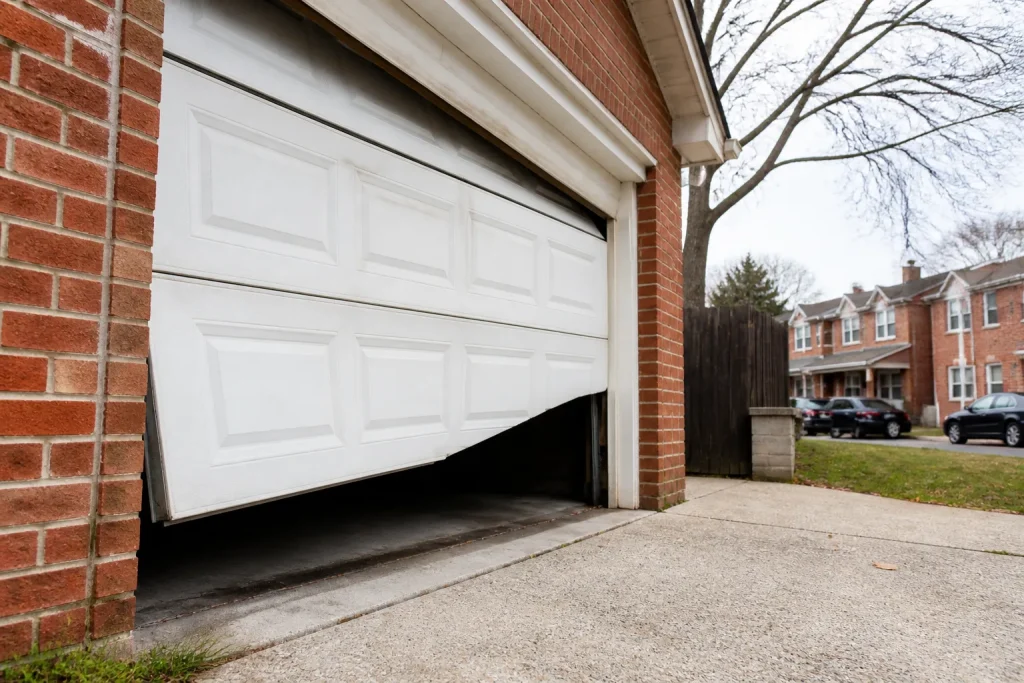
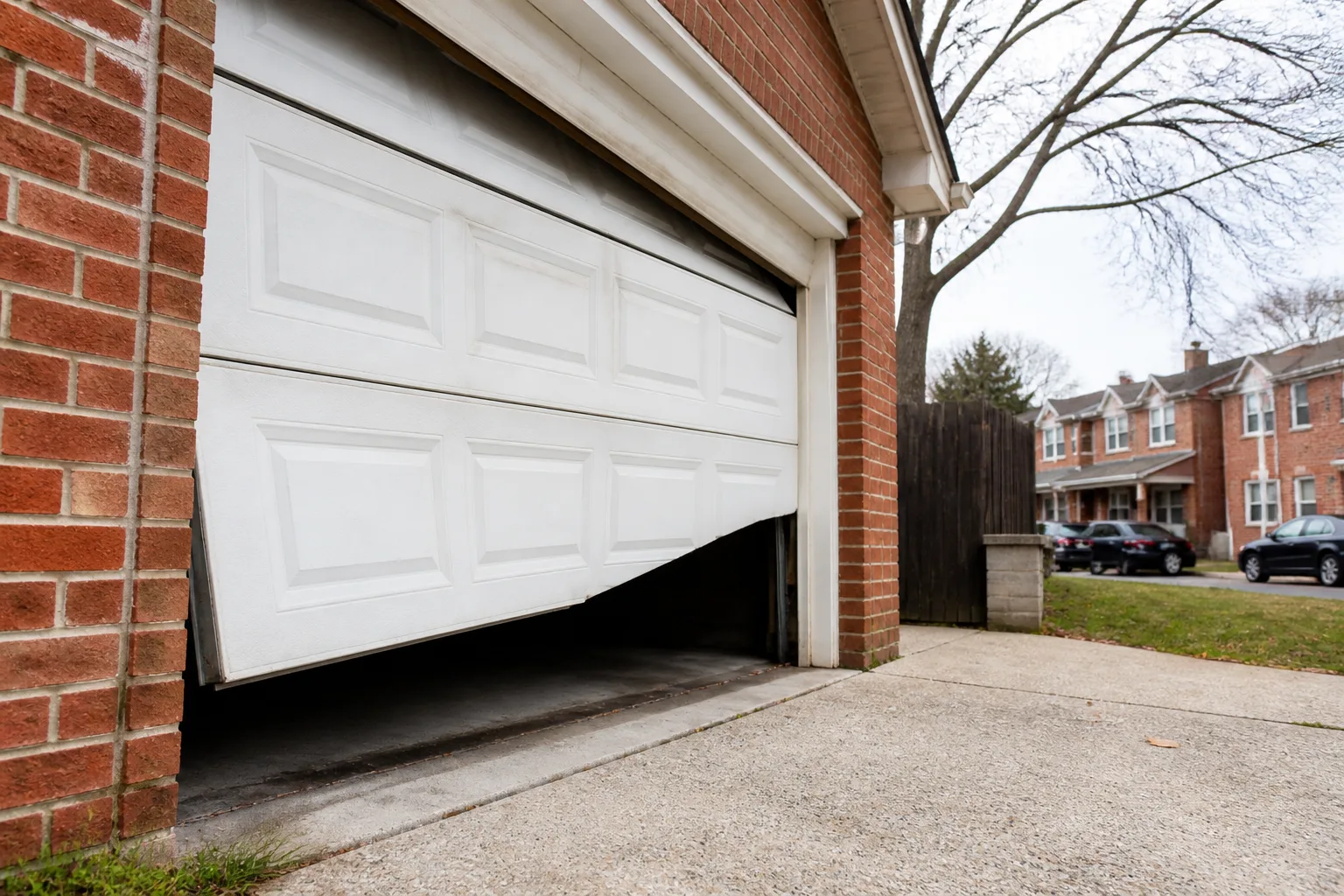
- Look at the tracks. Are the rollers sitting inside the track rails, or has one popped out? Is the door visibly crooked in the opening? A door sitting at an angle usually means a cable or spring let go and the door has shifted.
- Listen to the opener. If the motor runs but the door doesn’t move, the opener is probably fine and the problem is mechanical. If the motor is silent or hums without turning, the opener itself is the suspect. Brand-specific logic helps here: a Craftsman unit that hums and stalls is telling you something different than a LiftMaster that’s dead silent.
That whole pass takes about 90 seconds. What you’re really doing is sorting the problem into one of two buckets: a mechanical failure (spring, cable, track) or an operator failure (opener). That single distinction changes what happens next.
Why Is Doing Nothing the Right Move With a Broken Spring?
Because a garage door is heavy, and the springs are the only thing making it feel light. A standard door can weigh well over a hundred pounds. The springs balance that weight so the opener can lift it with a fraction of the force. When a spring snaps, that balance disappears. The door becomes a dead weight sitting on its cables and tracks, and everything you do to it from that point forward is stress it wasn’t designed to take.
Here’s what forcing it actually does:
- It bends panels. The bottom and top sections take the load when the door is dragged. Steel panels kink and never quite sit right again.
- It damages the cable drums. Cables jump their grooves and the drums get chewed up. Now you’re replacing hardware, not just a spring.
- It can drop the door. A door under uneven tension can come down hard and fast. That’s the injury risk, and it’s the reason spring work is a specialist job.
Torsion springs are under high tension even when the door is closed and looks perfectly still. We treat every spring repair as safety-critical work because it is. Our technicians have up to 10 years of experience with high-tension systems, and we still respect the tension every single time. That’s not caution for show. It’s the job. If you suspect a spring, leave the door exactly where it is and call (877) 378-7082. We answer 24/7, with fast dispatch from 7am to 7pm.
How Do You Use the Emergency Release Cord Safely?
You use it only when the door is fully closed and the springs are intact. The red release cord disconnects the door from the opener so you can move it by hand. That’s all it does. It does not fix a broken spring, and it does not make a heavy door light. If a spring has failed, pulling the release on an open or partly open door can let it slam down.
When it’s safe to use, here’s how it goes:
- Make sure the door is all the way down and at rest.
- Pull the cord straight down and toward the door. You should hear or feel it disengage.
- Lift the door slowly by hand. If it feels heavy, stop. Heavy means the springs aren’t doing their job, and the door should stay put.
One more thing to know: after a manual release, the door stays disconnected until you re-engage it. On most openers you do that by running the opener and letting the carriage reconnect, or by pulling the cord again at the right position. If you’re not sure how your unit re-engages, that’s a normal question for a Genie or Chamberlain owner, and it’s exactly the kind of thing we sort out over the phone.
Your Car Is Trapped. Can You Get It Out?
Maybe. It depends on whether the door is stable enough to move by hand. If the springs are intact and the door is merely disconnected from the opener, you can usually lift it, drive out, and lower it gently. If a spring or cable has failed, the door isn’t safe to lift, and the answer is to leave the car where it is and call for help.
Here’s how we think through a trapped-vehicle call in Govans:
- Springs intact, opener dead? Use the release cord and lift the door by hand. If it moves easily, drive out and close it slowly.
- Broken spring or loose cable? Don’t lift. The door can come down. Call us and we’ll talk you through your options.
- Door stuck open? The priority shifts to securing the house. More on that below.
- Door off-track and crooked? Don’t touch it. An off-track door under tension can shift suddenly.
If you truly need the car out and the door won’t cooperate, tell us that on the call. A trapped vehicle changes the urgency and helps us plan the visit. We answer 24/7, and we dispatch Sunday through Friday from 7am to 7pm.
What Should You Tell Us on the Emergency Call?
Tell us the door’s position, what you saw and heard, and whether a car is stuck. Those three facts cut diagnostic time dramatically and let us load the right parts before anyone leaves. When we already know it’s a torsion spring failure on a Clopay door, we’re not guessing at hardware when we arrive. That’s the difference between a one-trip repair and a callback.
Have these ready when you call:
- The door’s position. Fully closed, fully open, halfway, or crooked in the opening.
- What you observed. A visible gap in the spring, a hanging cable, a popped roller, a humming opener, or a dead motor.
- What the opener is doing. Lights on? Motor running? Nothing at all? If you know the brand, say so. Diagnostics differ between a LiftMaster board and a Genie unit.
- Whether a vehicle is trapped. This changes how fast we need to move.
- The door material and brand if you know it. Clopay, Amarr, Wayne Dalton, and Craftsman doors all have their own quirks. It helps.
You don’t need to diagnose it perfectly. Give us what you’ve got and we’ll take it from there. If the opener is the issue rather than the door, that’s a separate track, and you can read more about garage door opener repair while you wait.
How Do You Secure a Door Overnight If Repair Has to Wait?
You make the opening safe and the house closed, and you don’t try to fix the mechanism. If a same-night repair isn’t possible, the goal shifts from “get it working” to “keep it secure and keep everyone away from it.” An open garage is an open invitation, and a half-open door is a hazard for anyone who walks past it.
What actually helps:
- Close the door if it will close safely. If it’s off-track or crooked, don’t force it. Wedging a door that’s already shifted can drop it.
- Block the opening from the inside. Park a second vehicle close to the door if you can, or brace the opening with something solid. It won’t stop a determined intruder, but it buys time and keeps kids and pets out.
- Lock the entry door from the house. The door between the garage and the house is your real security line. Make sure it’s locked and deadbolted.
- Keep people clear of the door. A door under uneven tension isn’t a place to stand, lean, or store things. Tape off the area if you have curious kids.
If the door is stuck open and you’re in Govans, call (877) 378-7082. We answer 24/7, so even a call outside dispatch hours gets booked into the next opening, Sunday through Friday, 7am to 7pm.
When Should You Call a Pro Instead of Handling It Yourself?
Call a pro the moment springs or cables are involved. Those are the two components that carry the door’s weight and store the energy that makes the door feel light. They’re also the two that cause the serious injuries. A trained technician has the winding bars, the door-specific knowledge, and the respect for the tension that the job demands. This isn’t a “watch a video and grab a wrench” repair, and anyone who tells you otherwise hasn’t done one.
Call us if any of these are true:
- A spring is visibly broken, stretched, or hanging.
- A cable is loose, tangled, or off its drum.
- The door is crooked, off-track, or won’t sit level.
- The opener hums, clicks, or runs without moving the door.
- The door dropped, slammed, or moved on its own.
For the door itself, we handle garage door repair across every major brand, and when the door is beyond repair we can walk you through garage door installation so you’re choosing a door that fits your opening and your opener. Single-source means no handoffs between a door guy and an opener guy. One company, full system.
Related services in Govans: Garage Door Repair Govans for the full range of repair work when the failure isn’t an emergency.
The Bottom Line
Most of the damage in a garage door emergency happens in the twenty minutes after the failure, not during it. Don’t force the door. Identify the failure from a safe distance. Decide whether a trapped vehicle can safely exit. Tell us what you saw and what’s stuck. Secure the opening if repair has to wait. Those five habits keep a bad situation from getting worse, and they get the right parts to your door faster.
If you’re in Govans and need help, Garage Door Repair Govans offers free estimates. We answer 24/7 and dispatch Sunday through Friday from 7am to 7pm, with the price set by a written estimate before any work starts. Call (877) 378-7082.
Frequently Asked Questions
No. A broken spring means the door is far heavier than it looks, and lifting it by hand strains the panels, cables, and tracks, and can drop the door. Leave it closed and call (877) 378-7082 for a free estimate.
Look at the springs first. A visible gap in a torsion spring or a stretched-out extension spring means the spring failed. If the springs look intact and the opener hums or runs without moving the door, the opener is the suspect. Call (877) 378-7082 and we’ll help you sort it out.
We take same-day calls for urgent failures. We answer 24/7 and dispatch Sunday through Friday from 7am to 7pm, so a call outside dispatch hours is booked into the next opening. Call (877) 378-7082 for a free estimate.
The price is quoted and agreed before any work starts, and the written estimate sets the final price. If we find something the initial call didn’t reveal, we’ll show you before we proceed. Call (877) 378-7082.
Written by the team at Garage Door Repair Govans.
Need Garage Door Help?
Call Garage Door Repair Govans - the local pro we connect you with is licensed and insured, here with fast help in Govans.
(877) 378-7082